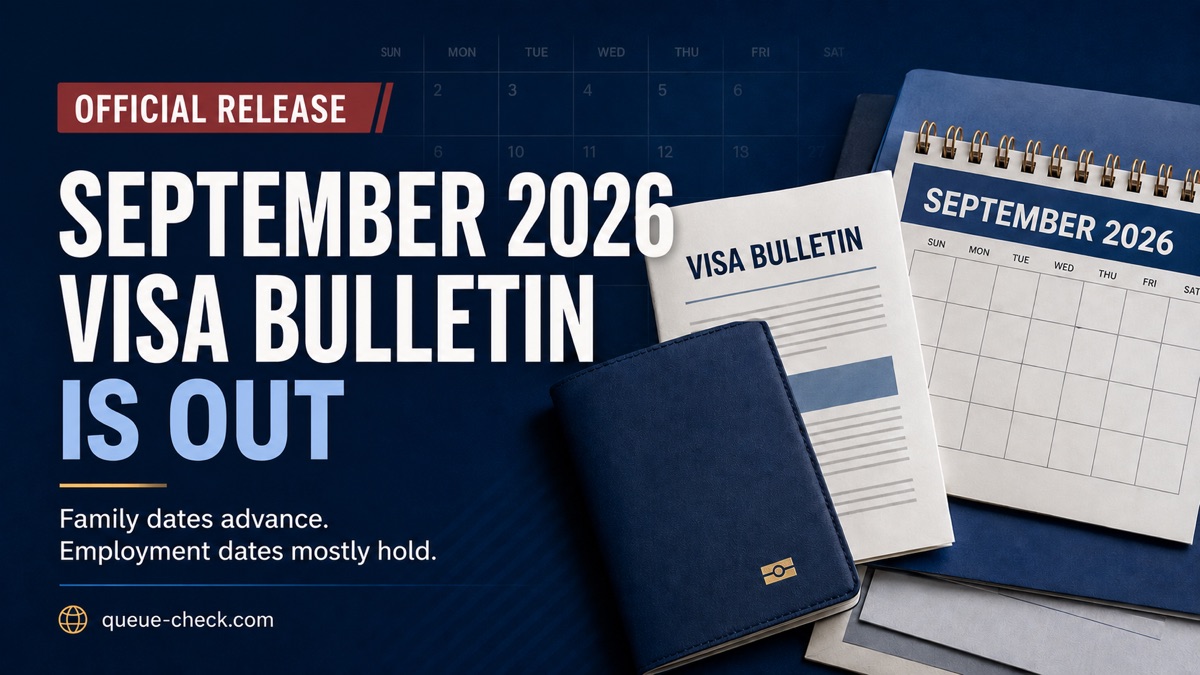
QueueCheck verified the September 2026 Visa Bulletin transcription on August 29, 2026. USCIS's filing-chart selection was checked separately on August 29, 2026.
USCIS selected Dates for Filing for family-sponsored adjustment filings and Final Action Dates for employment-based filings.
EB-1 India's Final Action Date is 15OCT22, compared with 15OCT22 in August 2026.
EB-2 India's Final Action Date is Unavailable, compared with Unavailable in August 2026.
EB-3 India's Final Action Date is 01JAN14, compared with 01JAN14 in August 2026.
In September 2026, family-sponsored dates moved broadly forward, while most employment-based dates stayed where August 2026 left them. No Final Action cut-off moved backward.
In September 2026, family-sponsored dates moved broadly forward, while most employment-based dates stayed where August 2026 left them. No Final Action cut-off moved backward. The full comparison appears below.
Release analysis
The movements behind September 2026
Read the family and employment changes as a focused news story, with the headline, comparisons and filing status generated from the same verified tables shown on this page.
A visa number can be authorized only when the priority date is earlier than the cut-off for the category and chargeability area.
September 2026 Final Action Dates, Family-sponsored
Category
All other chargeability areas
China (mainland born)
India
Mexico
Philippines
F1: unmarried adult children of U.S. citizens
22JAN20
22JAN20
22JAN20
01JAN08
01MAY13
F2A: spouses and children of permanent residents
22AUG26
22AUG26
22AUG26
22AUG25
22AUG26
F2B: unmarried adult children of permanent residents
22AUG19
22AUG19
22AUG19
15FEB09
01JUN13
F3: married children of U.S. citizens
22OCT14
22OCT14
22OCT14
01JUL01
22FEB06
F4: siblings of adult U.S. citizens
22OCT11
22OCT11
01NOV06
08APR01
22AUG07
September 2026 Final Action Dates, Employment-based
Category
All other chargeability areas
China (mainland born)
India
Mexico
Philippines
EB-1: priority workers
C
01JUL23
15OCT22
C
C
EB-2: advanced degrees and exceptional ability
C
01SEP21
U
C
C
EB-3: skilled workers and professionals
01SEP24
01JAN22
01JAN14
01SEP24
01AUG23
EB-3: other workers
01APR22
01MAY19
01JAN14
01APR22
01DEC21
EB-4: special immigrants
15DEC22
15DEC22
15DEC22
15DEC22
15DEC22
EB-4: certain religious workers
15DEC22
15DEC22
15DEC22
15DEC22
15DEC22
EB-5: unreserved investor visas
C
01DEC16
U
C
C
EB-5 set-aside: rural (20%)
C
C
C
C
C
EB-5 set-aside: high unemployment (10%)
C
C
C
C
C
EB-5 set-aside: infrastructure (2%)
C
C
C
C
C
September 2026 Dates for Filing
These dates control document submission and adjustment filing only when USCIS designates this chart for the relevant preference type.
September 2026 Dates for Filing, Family-sponsored
Category
All other chargeability areas
China (mainland born)
India
Mexico
Philippines
F1: unmarried adult children of U.S. citizens
01FEB20
01FEB20
01FEB20
01DEC08
22APR15
F2A: spouses and children of permanent residents
C
C
C
C
C
F2B: unmarried adult children of permanent residents
01SEP19
01SEP19
01SEP19
15MAY10
01OCT13
F3: married children of U.S. citizens
01NOV14
01NOV14
01NOV14
15JUL01
08AUG06
F4: siblings of adult U.S. citizens
01NOV11
01NOV11
15DEC06
30APR01
22MAR08
September 2026 Dates for Filing, Employment-based
Category
All other chargeability areas
China (mainland born)
India
Mexico
Philippines
EB-1: priority workers
C
01DEC23
01DEC23
C
C
EB-2: advanced degrees and exceptional ability
C
01JAN22
15JAN15
C
C
EB-3: skilled workers and professionals
C
08JAN22
15JAN15
C
01JAN24
EB-3: other workers
01AUG22
01OCT19
15JAN15
01AUG22
01AUG22
EB-4: special immigrants
01JAN23
01JAN23
01JAN23
01JAN23
01JAN23
EB-4: certain religious workers
01JAN23
01JAN23
01JAN23
01JAN23
01JAN23
EB-5: unreserved investor visas
C
01MAR17
01MAY24
C
C
EB-5 set-aside: rural (20%)
C
C
C
C
C
EB-5 set-aside: high unemployment (10%)
C
C
C
C
C
EB-5 set-aside: infrastructure (2%)
C
C
C
C
C
What changed from August 2026
Unchanged rows are omitted. Matching country movements are grouped so advances, retrogressions, Current and Unavailable changes remain easy to scan.
Final Action Dates
F3: married children of U.S. citizens advanced 890 days for All other chargeability areas, China (mainland born), India.
F4: siblings of adult U.S. citizens advanced 781 days for All other chargeability areas, China (mainland born).
F2B: unmarried adult children of permanent residents advanced 598 days for All other chargeability areas, China (mainland born), India.
F1: unmarried adult children of U.S. citizens advanced 403 days for All other chargeability areas, China (mainland born), India.
EB-4: special immigrants advanced 61 days for All other chargeability areas, China (mainland born), India, Mexico, Philippines.
EB-4: certain religious workers advanced 61 days for All other chargeability areas, China (mainland born), India, Mexico, Philippines.
F1: unmarried adult children of U.S. citizens advanced 31 days for Mexico.
F2A: spouses and children of permanent residents advanced 31 days for All other chargeability areas, China (mainland born), India, Mexico, Philippines.
F4: siblings of adult U.S. citizens advanced 21 days for Philippines.
Dates for Filing
F3: married children of U.S. citizens advanced 610 days for All other chargeability areas, China (mainland born), India.
F4: siblings of adult U.S. citizens advanced 497 days for All other chargeability areas, China (mainland born).
F2B: unmarried adult children of permanent residents advanced 243 days for All other chargeability areas, China (mainland born), India.
F1: unmarried adult children of U.S. citizens advanced 231 days for All other chargeability areas, China (mainland born), India.
Diversity Visa cut-offs in the September 2026 bulletin
These are regional lottery rank numbers, not dates. A selectee can be processed when their rank number is below the cut-off shown for their region, which is the reverse of how the preference charts above work. Where a country is listed separately, its lower number replaces the regional one for applicants charged to it.
September 2026
Diversity Visa regional rank cut-offs for September 2026
Region
Rank cut-off
Countries listed separately
Africa
101,250
Algeria 85,000, Egypt 50,000
Asia
40,000
Nepal 13,500
Europe
47,500
None
North America (Bahamas)
Current
None
Oceania
3,000
None
South America and the Caribbean
4,750
None
What the September 2026 bulletin says in its own notes
Quoted from the published document, with the Department's own section letters. Nothing here is paraphrased or shortened.
A. F2A numbers exempt from the per-country limit
For September, F2A numbers EXEMPT from per-country limit are authorized for issuance to applicants from all countries with priority dates earlier than 22AUG25. F2A numbers SUBJECT to per-country limit are authorized for issuance to applicants chargeable to all countries EXCEPT MEXICO, with priority dates beginning 22AUG25 and earlier than 22AUG26. All F2A numbers provided for MEXICO are exempt from the per-country limit.
B. DV-2026 annual limit and the end of the program year
Entitlement to immigrant status in the DV category lasts only through the end of the fiscal (visa) year for which the applicant is selected in the lottery. The year of entitlement for all applicants registered for the DV-2026 program ends as of September 30, 2026. DVs may not be issued to DV-2026 applicants after that date. Similarly, spouses and children accompanying or following to join DV-2026 principals are only entitled to derivative DV status until September 30, 2026. DV availability through the end of FY-2026 cannot be taken for granted. Numbers could be exhausted prior to September 30.
C. Availability of Family-Sponsored and Employment-Based Visas
Immigrant visa issuance rates have decreased in FY 2026, in part due to the policies the President has put in place since January 2025 to protect national security and the integrity of our immigration process, as well as the impact of posts that have faced limited or suspended visa operations in response to global events. Consequently, to make visas available in accordance with sections 201-203 of the INA to sufficient prospective immigrants to use immigrant visa numbers that are available in FY 2026, dates for filing and final action dates have been advanced across various immigrant visa categories throughout recent months. Note that as additional immigrant visa demand materializes, or administration actions are amended, retrogression may become necessary in the coming weeks to keep issuances within annual limits. Visa categories may become “Unavailable” prior to the end of the fiscal year if annual limits, category limits, or pro-rated per-country limits are reached. This situation is being continually monitored, and any necessary adjustments will be made accordingly.
D. Determination of the Numerical Limits on Immigrants Required Under the Terms of the INA
The Department of State has determined the Family and Employment preference numerical limits for FY-2026 in accordance with the terms of Section 201 of the INA. These numerical limitations for FY-2026 are as follows: Worldwide Family-Sponsored preference limit: 226,000. Worldwide Employment-Based preference limit: 186,317. Under INA Section 202(a)(2), the per-country limit is fixed at 7% of the combined total family and employment annual limits. For FY-2026 the per-country limit is therefore 28,862. The dependent area annual limit is 2%, or 8,247. Note that these figures do not account for carryover provisions in accordance with INA 203(b)(5)(B). With these carryover visa numbers included, the per-country limit is 29,136 and the dependent area limit is 8,325.
E. Visa Availability in the Employment-Based First Preference (EB-1) Final Action Date for India
High demand and number use by aliens chargeable to India in the EB-1 visa category may necessitate making the category unavailable in the coming weeks if India’s pro-rated limit in the EB-1 category is reached before the fiscal year ends. This situation will be continually monitored, and any necessary adjustments will be made accordingly.
F. Visa Availability in the Employment-Based Second Preference (EB-2) Category
Sufficient demand and increased number use in the EB-2 visa category may make it necessary to retrogress the final action date or make the category unavailable before the end of the fiscal year to hold number use within the maximum allowed under the FY 2026 annual limit. This situation will be continually monitored, and any necessary adjustments will be made accordingly.
G. Visa Availability in the Employment-Based Fifth Preference Unreserved (EB-5) Category
Sufficient demand and number use in the EB-5 unreserved visa category may make it necessary to retrogress the final action date or make the category unavailable before the end of the fiscal year to hold number use within the maximum allowed under the FY 2026 annual limit. This situation will be continually monitored, and any necessary adjustments will be made accordingly.
A bulletin month records visa availability. These QueueCheck resources cover the practical arrival and permanent-resident tasks that become relevant later.