
Reading the numbers
How to read USCIS processing times, and why the date that lets you ask is a different number
Updated Aug 10, 2026
Written and checked by C. Githii. Last checked August 10, 2026. Research and verification follow the QueueCheck editorial standards. How we verify information
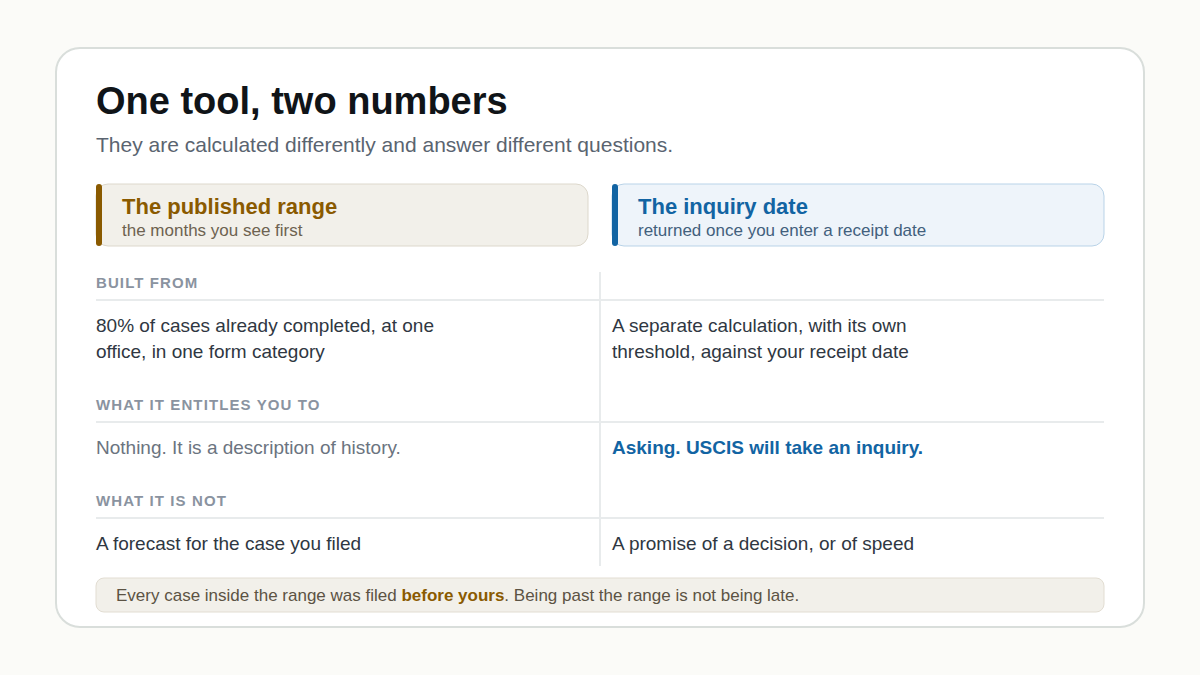
The processing-times tool looks like it answers one question and actually answers two, using different arithmetic for each. The visible answer is a range of months, and almost everyone reads it as a forecast: file today, wait that long. It is not a forecast. It is a description of cases USCIS has already finished, at one office, for one form category, assembled from a recent stretch of history and refreshed on a monthly cycle.
The second answer is the one that carries a right attached to it. Enter a receipt date and the tool also produces the date from which USCIS will accept an inquiry about a case, and that date comes from a different calculation with a different threshold. People wait on the visible range, conclude they are late, and discover the agency will not discuss the case yet. The gap between those two numbers is where most of the frustration on this page lives, so this guide takes them apart one at a time.
USCIS N-400 official timing and account context
OfficialUSCIS N-400: use the official USCIS processing-times tool by field office
Reader timelines are being collected for this service. The tracker page keeps the current official figure and what people who applied in your month are reporting.
Wait anxiety for USCIS N-400
Editorial score from official sources. Last checked 23 July 2026.
Reading the tool without misreading it
Each step below narrows what the answer describes. Skipping any of them produces a number that belongs to somebody else's case.
- 1Choose the form, then the category under it
- 2Choose the office that holds the case
- 3Read the range as history
- 4Enter your receipt date
- 5Wait for that date before inquiring
- 6After the inquiry date, ask, and keep the record
Choose the form, then the category under it
The step most often done halfwayMany forms carry subcategories that are adjudicated on separate tracks, and the tool asks for the specific one rather than the form alone. A number pulled from the wrong subcategory is not an approximation of the right one; it describes a different queue.
Choose the office that holds the case
Named on the receipt noticeWork is distributed across service centers and field offices, and each publishes its own figures. The receipt notice names the one holding your file, which may not be the nearest to home and can differ from where an interview is eventually scheduled.
Read the range as history
Refreshed monthlyThe figure describes how long it took to complete most cases, eighty percent of them, over a recent multi-month window at that office. Every case inside it was filed before yours. It carries no commitment about the file you submitted.
Enter your receipt date
The step that produces the useful dateWith a receipt date, the tool returns the earliest date on which USCIS will accept an inquiry about the case. This is calculated separately from the displayed range, against a stricter completion threshold, and offset by how long the case has already been pending.
Wait for that date before inquiring
Not a queue you can join earlyBefore the inquiry date arrives, the agency treats the case as within normal processing and will not take a status inquiry on it. Calling earlier does not create an exception; it produces the same answer the tool already gave.
After the inquiry date, ask, and keep the record
A service request, not an escalationAn inquiry opens a service request asking the office to look at why the case is outstanding. It does not adjudicate anything, and it does not move a case ahead of others. What it produces is a documented response, which is the thing later options build on.
Why the range cannot predict your case
Two properties make the published range a description rather than a forecast. It is retrospective, built from cases that finished, so every file it summarises entered the system earlier than yours and travelled through whatever conditions applied then. And it is a spread rather than a midpoint: it is drawn wide enough to cover most completions at that office, which means the slower end of it is doing as much work as the faster end.
That spread is often read as a promise about its own lower bound. It is not. A case landing near the fast end and a case landing near the slow end are both inside the published behaviour of that office, and neither outcome indicates anything went right or wrong. The range describes where cases land, not where yours will.
The practical consequence is that the range answers planning questions and not much else. It is the right input for deciding whether to renew a document, when to expect to need time off, or whether a related filing needs to happen first. It is the wrong input for deciding whether something has gone wrong, because that question has its own number.
The second number, and why it is stricter
The inquiry date is not read off the displayed range. USCIS calculates it against a higher completion threshold, the point by which the large majority of cases of that type are finished, and then subtracts the time the case has already been pending. That is why two people with the same form at the same office can be told different things on the same day: their receipt dates place them at different points in the same calculation.
The stricter threshold is doing something specific. A case that has passed the point where most cases finish is unremarkable; a case that has passed the point where almost all of them finish is the one worth a second look. The agency has set the door where the evidence of an outlier begins, not where the average ends.
This is also why the arithmetic can feel like it is moving away from you. The threshold is computed from figures that refresh, so a month in which that office's completions slowed can push an inquiry date later even though the case sat still. Nothing has been reset; the definition of an outlier changed underneath it.
What being outside the range actually gets you
Passing the inquiry date unlocks a procedural step, not a decision. The service request that follows asks the office holding the file to review why it is outstanding and respond, and the responses range from a substantive explanation to a restatement that the case remains pending. Neither outcome is a defect in the process; the request is a prompt, and prompting is what it does.
What makes it worth doing anyway is the record. A documented inquiry, and the response to it, is the foundation of every further option: escalation through the ombudsman's office, a congressional inquiry, or, at the far end, litigation to compel a decision. Each of those asks what has already been tried, and an undocumented phone call answers that question badly.
None of this is a route to a faster decision on the merits, and treating it as one leads people to spend money on it. The honest description is narrower and still useful: it converts silence into a written answer, and it puts a case on the record as one the applicant has actively pursued.
Reading the same tool a month later
Because the figures refresh on a monthly cycle, the answer for an unchanged case can change between visits, in either direction. The range widening does not mean a case slowed down; it means completions at that office spread out. The range narrowing does not mean the case sped up. The only thing that moved is the summary of other people's finished cases.
The comparison people find most alarming, an office whose figures are far worse than a neighbouring one's, usually reflects workload distribution rather than diligence. Offices receive different mixes of work, carry different inventories, and finish cases at different rates as a result. There is no mechanism by which an applicant transfers a case to a faster office because its published figures look better.
A steadier habit than watching the range is watching your own two dates: the receipt date, which is fixed, and the inquiry date, which the tool recomputes. Those two describe your position. Everything else on the page describes the office.
Where the tool gets misread
My case passed the top of the published range but USCIS still will not take an inquiry.
What helps
Those are different thresholds, and the inquiry door is the stricter one. The date the tool returns for your receipt date is the operative one; the displayed range does not entitle you to anything.
The estimate got longer since last month and my case has not moved.
What helps
The figures refresh against recently completed cases, so the summary can shift while your file sits unchanged. It is a statement about that office's recent output, not a re-estimate of your case.
Another office shows much faster times for the same form.
What helps
Offices carry different workloads and inventories, and cases are not reassigned on the basis of published figures. Moving house to chase a faster office also changes which office holds the case, which restarts more than it fixes.
I filed several forms together and only one shows a long wait.
What helps
Each form is adjudicated on its own track with its own figures, and concurrently filed applications routinely finish at different times. One slow line among several is the normal shape of a bundled filing.
I submitted an inquiry and the reply told me nothing.
What helps
A response confirming the case remains pending is still a documented response, and it is the record later steps rely on. If the case continues past the point where an inquiry has been answered without movement, the ombudsman route and legal advice are the next questions, not another identical inquiry.
Help readers with the same USCIS N-400 milestone
Official numbers cannot show what applicants actually experience month by month. Sharing your application and decision dates helps the next reader see the real pace. Under a minute, dates only, nothing personal.
Share my USCIS N-400 datesUSCIS N-400 status questions before you refresh again
Is the published range a deadline USCIS has to meet?
No. It carries no commitment about any individual case. It summarises how long completed cases took at one office for one category over a recent window.
Why does the tool ask for my receipt date?
To calculate the earliest date it will accept an inquiry about your case. That date depends on how long the case has already been pending, so it cannot be read off the range alone.
My receipt date is inside the range shown. What does that mean?
That your case sits within the behaviour the office has recently shown, which is the tool's way of saying nothing looks unusual. It is not a statement that a decision is close.
Does submitting an inquiry make my case slower or annoy the officer?
There is no published mechanism by which an inquiry penalises a case, and the agency provides the route deliberately. It also does not advance a case ahead of others; it asks for a status response.
Can I use the range to argue my case is unreasonably delayed?
The stricter inquiry threshold is the more meaningful marker, and what follows depends on the specific facts of the case. That is a question for an attorney rather than a page like this one, and the documented inquiry is what such advice is usually built on.
Why do lawyers' sites quote different numbers than the tool?
Third-party trackers aggregate self-reported timelines, which measure a different population than the agency's completed-case figures. Neither is dishonest; they are counting different things, and only the official tool governs the inquiry date.
Should I keep checking the tool every day?
The figures update on a monthly cycle, so daily checking returns the same answer with more anxiety attached. The two dates worth knowing are your receipt date and your inquiry date.