
US Green Card reference
How to read the Visa Bulletin without misreading your own case
Updated Aug 5, 2026
Written and checked by Walter Armani. Last checked August 5, 2026. Research and verification follow the QueueCheck editorial standards. How we verify information
The Visa Bulletin is a monthly table published by the State Department, and it decides when a green card case can move rather than how fast any agency works. People read it wrong in a consistent way: they find their category, read one date, and conclude something about their case that the table never said.
Two things cause most of that. There are two charts, not one, and they control different actions. And the chart that governs adjustment-of-status filings is designated by USCIS each month, so the answer to which chart applies to me changes on a schedule nobody outside the agencies controls. This page explains the mechanics so any month's bulletin can be read correctly, including the ones that bring bad news.
US Green Card official timing and account context
OfficialUS Green Card: check the current Visa Bulletin and USCIS case updates
Reader timelines are being collected for this service. The tracker page keeps the current official figure and what people who applied in your month are reporting.
How a case meets the bulletin
The bulletin never speaks about an individual case. It publishes cut-offs, and a case's position against them is arithmetic the reader does themselves.
- 1A priority date is established
- 2The category and country row is located
- 3USCIS names which chart applies
- 4The date becomes reachable, or does not
- 5Final action, when a number is actually allocated
A priority date is established
At the start of the processThe priority date is the place in line, set when the qualifying petition or labour certification is filed. Everything the bulletin later says is read against that single date, which is why knowing it exactly matters more than any monthly headline.
The category and country row is located
Every monthCut-offs are published per preference category and per country of chargeability, which usually means country of birth rather than citizenship. A row for one country says nothing about another, and mixing them up is the most frequent misreading of the whole document.
USCIS names which chart applies
Monthly, alongside the bulletinFor adjustment of status inside the United States, USCIS designates which chart applicants may use that month, and it can name different charts for family-sponsored and employment-based categories. That designation is published on the USCIS filing-charts page, and it can change from one month to the next.
The date becomes reachable, or does not
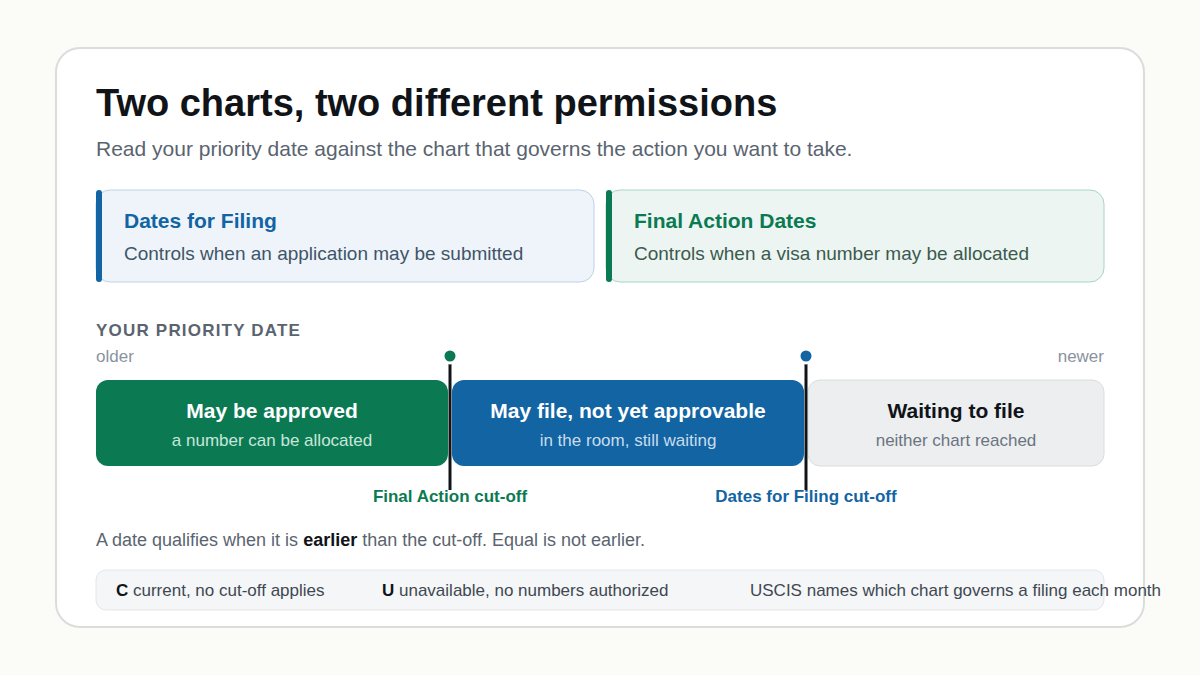
The waiting partA priority date earlier than the applicable cut-off means the action that chart controls is open. Later than the cut-off means waiting. Nothing else about the case changes in the meantime, and no filing accelerates the cut-off's movement.
Final action, when a number is actually allocated
The end of the queueApproval requires an available visa number under the Final Action Dates chart. A case can be filed, complete, and interview-ready and still wait here, which is why people describe being approved in every respect except the one that matters.
Two charts, two different permissions
The Final Action Dates chart governs when a case can actually be approved and a green card granted. The Dates for Filing chart governs when an application may be submitted, and it usually sits ahead of the final-action chart, which is why a case can be filed long before it can be approved.
That gap explains a common and painful confusion. Being allowed to file is not being close to approval; it is permission to join the room where the approval eventually happens. Applicants who read the filing chart as a prediction of approval timing are reading a submission rule as an outcome rule.
Consular processing works differently from adjustment: the State Department's own instructions to applicants abroad govern which dates apply there, and the National Visa Center works from them. The USCIS chart designation is about filings made inside the United States.
C means go, U means the category has stopped
A C in a cell means current: no cut-off applies, and every qualified applicant in that category and country may act. A U means unavailable: no visa numbers are authorised for that category and country, so nothing moves regardless of how old the priority date is.
A U is not a denial and not a policy change aimed at anyone. It usually means the annual or per-country allocation for that category has been exhausted for the fiscal year, and the category is expected to reopen when a new year's numbers become available. It is the bluntest thing the bulletin can say, and the most alarming to read cold.
Dates can move backwards, and that has a name
Retrogression is a cut-off moving to an earlier date than the month before. It happens when demand in a category exceeds the numbers available, so the queue that appeared to have reached a certain date has to be pulled back to fit within the supply.
For a case already filed, retrogression does not undo the filing; it removes the availability that would have allowed approval, and the case waits until the date advances past it again. For a case not yet filed, it can close a window that was open the previous month. Neither situation reflects anything about the applicant, and neither can be appealed, because no decision was made about them.
The fiscal year is the tide underneath everything
Immigrant visa numbers are allocated by fiscal year, which begins on October 1. That single fact drives much of the bulletin's behaviour: supply is finite within a year, allocation is managed month by month against demand, and categories that run out of numbers late in the year show unavailability until the new year's supply arrives.
This is why bulletins near the end of a fiscal year and the first bulletins of a new one deserve extra attention, and why comparing a September cut-off with an October one without accounting for the reset produces conclusions that are not there. Read consecutive months as a series rather than treating any single month as a trend.
What the bulletin cannot tell you
It cannot predict when a specific case will be approved. Cut-off movement responds to demand data the public does not see, and prediction sites that project future dates are modelling, not reporting. Their forecasts are entertainment for the anxious, not a basis for booking a life around.
It also says nothing about processing speed. An agency can be fast while the bulletin holds a case for years, and slow while the bulletin is wide open. Those are two independent constraints, and separating them is the single most useful habit a green card applicant can build.
Misreadings that cost people real decisions
Reading the wrong chart for the month
What helps
Check the USCIS filing-charts page for the month in question before concluding anything about a filing window. The designation can differ between family-sponsored and employment-based categories in the same month, and it is the only thing that decides which chart applies to an adjustment filing.
Using the wrong country row
What helps
Chargeability usually follows country of birth, not citizenship or residence. Cross-chargeability rules can apply in some family situations, which is a question for counsel rather than a table lookup, but reading a row for the wrong country is a self-inflicted error worth ruling out first.
Treating a filing date as an approval estimate
What helps
The Dates for Filing chart opens the door to submitting; the Final Action Dates chart is the one attached to approval. A case filed under the first can wait a long time for the second, and that wait is not a sign anything went wrong.
Panicking at U or at retrogression
What helps
Both describe supply, not your case. Nothing was decided about you, nothing was lost from your file, and your priority date does not change. What changes is when the queue can next reach it.
Building plans on a prediction site
What helps
Projections of future cut-offs are private modelling. They can be useful for calibrating expectations and are worthless as commitments, so no lease, resignation, or school enrolment should depend on one.
Help readers with the same US Green Card milestone
Official numbers cannot show what applicants actually experience month by month. Sharing your application and decision dates helps the next reader see the real pace. Under a minute, dates only, nothing personal.
Share my US Green Card datesUS Green Card status questions before you refresh again
Which chart do I use?
For adjustment of status inside the United States, whichever chart USCIS designates for your category for that month, published on its filing-charts page. The designation can differ between family-sponsored and employment-based categories, and it can change month to month. For consular processing abroad, the State Department's instructions govern.
What does C mean in the Visa Bulletin?
Current. No cut-off applies to that category and country for that chart, so qualified applicants may take the action that chart controls without waiting on a priority date.
What does U mean?
Unavailable. No visa numbers are authorised for that category and country, typically because the allocation has been used up for the fiscal year. Cases wait; nothing about them has been decided or lost.
My priority date was current last month and now it is not. What happened?
That is retrogression: the cut-off moved to an earlier date because demand exceeded available numbers. A filed application stays filed; it simply cannot be approved until the date advances past your priority date again.
Does an earlier priority date make my case faster?
It makes you earlier in the queue, which is different. Position determines when a visa number reaches you; it does not affect how long an agency takes to adjudicate the petition or application itself.
Can anything make the cut-off move faster for me?
No. Cut-offs are set from aggregate demand and statutory supply, and no filing, fee, or inquiry changes them for an individual. What is within a case's control is being complete and ready when the date does move.
Check your priority date against the current bulletin
Everything this guide explains, done for your date: pick your category and country of chargeability, enter the priority date, and read where it stands under both of the current bulletin's charts, including whichever one USCIS has designated for filings.