
United States · EB-5 investor fees
USCIS finalizes EB-5 fee increases: I-526E rises to $7,850
The September 2026 EB-5 final rule raises investor petition fees and the separate Integrity Fund charge. Compare all fees, filing timing and pending-case implications.
Published . Updated .
Reported and checked by the QueueCheck news desk. Last checked September 29, 2026. How we verify information
Higher investor fees are finalized
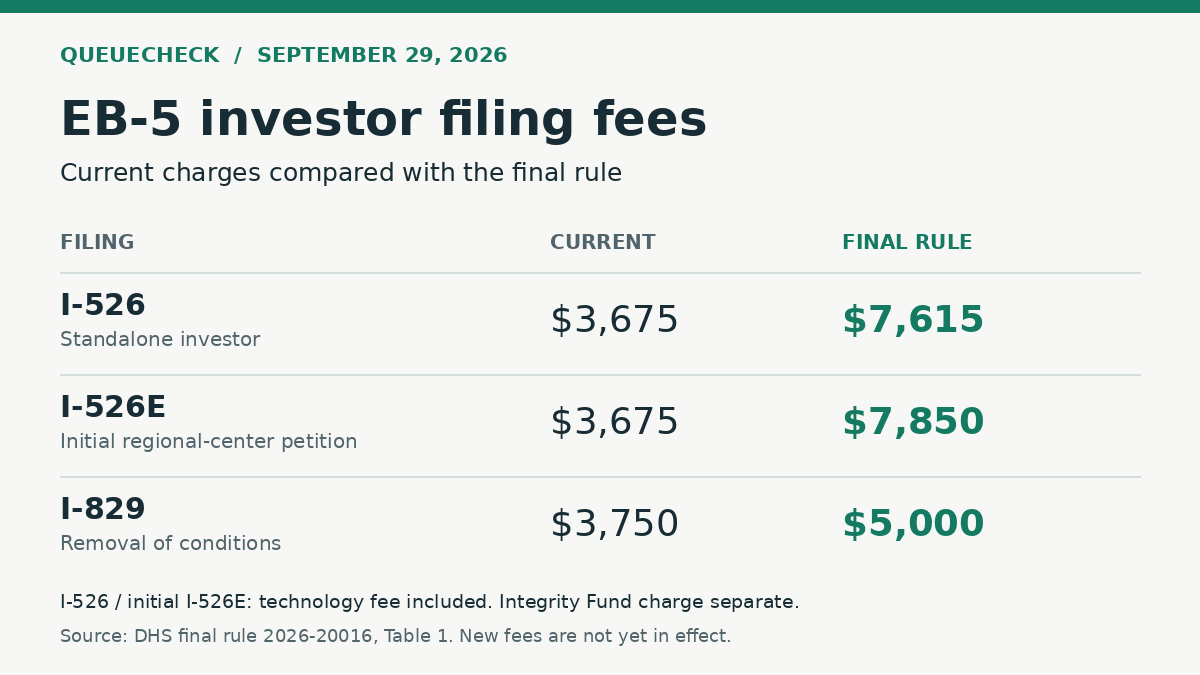
USCIS has finalized higher fees for the main EB-5 investor petitions. The rule released for public inspection on September 29, 2026 sets Form I-526 at $7,615, an initial I-526E at $7,850 and I-829 at $5,000. Regional-center investors must also budget for a separate $1,100 Integrity Fund charge. These are future fees: the public-inspection document schedules the rule for Federal Register publication on September 30 and still expresses its effective date as 60 days after publication.
Investors and regional-center filers
Standalone EB-5 investors preparing I-526, regional-center investors preparing I-526E, conditional permanent residents approaching I-829, and regional centers, project operators and promoters with their own filing obligations.
Petition fees and separate charges
- The final rule's Table 1 compares the new amounts with fees USCIS currently collects after the 2025 court-ordered rollback. I-526 rises by $3,940, initial I-526E by $4,175 and I-829 by $1,250.
- The $75 technology fee is already included in the displayed $7,615 I-526 and $7,850 initial I-526E amounts. Adding another $75 to those totals would count it twice.
- The I-526E Integrity Fund charge is separate. Adding $7,850 and $1,100 gives a future initial regional-center petition budget of $8,950 for these two USCIS charges, compared with $4,675 under the current schedule.
- Some regional-center charges fall. The I-956 amendment fee drops to $9,835 and the I-956G annual-statement fee to $2,165. The rule also establishes fees for I-527, I-956H and I-956K.
Publication, effective date and postmark rule
Official status checked September 29, 2026: final rule on public inspection, scheduled for Federal Register publication September 30. This is the final fee rule following the October 23, 2025 proposal.
Effective-date wording in the inspected PDF: 60 days after Federal Register publication, with the calendar date still a placeholder. Confirm the completed date and USCIS implementation instructions before scheduling a filing.
The rule applies its new fees to applications, petitions or requests postmarked on or after its effective date. The announcement date is not the fee-change date.
EB-5 fees: current charges and the final rule
2026-09-29
Amounts in U.S. dollars, transcribed from Table 1 of DHS's September 29, 2026 public-inspection final rule. Current means the fees USCIS is collecting, not the higher 2024 schedule or the October 2025 proposal.
Initial I-526E plus Integrity Fund
$8,950
$7,850 petition and technology fee + $1,100 separate charge under the final rule.
Increase in those two charges
$4,275
QueueCheck calculation: $8,950 minus the current $4,675 combined amount.
| Filing or charge | Current fee | Final-rule fee | Change |
|---|---|---|---|
| I-526 standalone investor, including technology fee | $3,675 | $7,615 | +$3,940 |
| I-526E initial regional-center investor petition, including technology fee | $3,675 | $7,850 | +$4,175 |
| I-526E amendment | $3,675 | $7,775 | +$4,100 |
| I-527 amendment to legacy I-526 (new form) | $0 | $10,330 | New fee |
| I-829 removal of conditions | $3,750 | $5,000 | +$1,250 |
| I-956 initial regional-center designation | $17,795 | $44,115 | +$26,320 |
| I-956 amendment | $17,795 | $9,835 | -$7,960 |
| I-956F investment approval | $17,795 | $42,675 | +$24,880 |
| I-956G annual statement, amendment or supplement | $3,035 | $2,165 | -$870 |
| I-956H bona fides of persons involved | $0 | $65 | New fee |
| I-956K promoter registration | $0 | $2,165 | New fee |
| I-526E Integrity Fund charge (separate from petition fee) | $1,000 | $1,100 | +$100 |
| Regional-center annual Integrity Fund fee, 20 or fewer total investors | $10,000 | $11,000 | +$1,000 |
| Regional-center annual Integrity Fund fee, more than 20 total investors | $20,000 | $22,000 | +$2,000 |
The final rule and USCIS filing schedule
- DHS final rule 2026-20016, Table 1, PDF pages 7–8
Check the effective filing instructions
- The rule's I-526 and initial I-526E totals include the applicable $75 technology fee. The separate Integrity Fund charge is listed on its own row.
- These amounts exclude investment capital, private project or administrative charges, legal fees, and any separate immigration applications. A row showing $0 means no current fee for that listed filing, not that all underlying activity is cost-free.
- This is a comparison for planning. Use the effective USCIS schedule and instructions for the exact filing, payment method and payment breakdown.
Already filed or paid an earlier fee
Your I-526E is already pending
The final rule's applicability language concerns filings postmarked on or after the effective date. It does not direct every pending investor to top up a previously accepted petition. A later amendment or separate filing needs its own fee check.
You paid the higher 2024 fee
In its response to refund comments, DHS says the court order did not require reimbursement and declines to create refunds through this rule. The new fee comparison is not a refund offer.
EB-5 filing-cost questions
Is $7,850 the full cost of an initial I-526E filing?
No. It includes the applicable technology fee, but the final rule separately sets the I-526E Integrity Fund charge at $1,100. Those two charges total $8,950. Investment capital, private charges and other applications are outside that total.
Does paying the higher fee move my EB-5 priority date?
The fee rule changes charges and funding arrangements. It does not move Visa Bulletin cutoff dates or promise faster adjudication of an individual case. Check your category and chargeability separately from the fee for your form.
Budget changes and processing goals
For an investor preparing an initial regional-center petition, the practical change is a $4,275 increase across the petition and Integrity Fund charges. Ask for an itemized budget so these government charges are distinguishable from money invested in the project and private administrative or professional fees.
DHS says the program-specific fee study is intended to recover the cost of administering EB-5, support statutory processing goals and fund integrity work. The rule identifies a projected gap of about $48.4 million between EB-5 costs and revenue under current fees.
Higher fees do not establish an earlier Visa Bulletin cutoff or an individual approval deadline. Petition adjudication, visa-number availability and the final adjustment or consular stage remain separate questions.
Before mailing an EB-5 filing
- Identify the exact form and filing type. An initial I-526E and an amendment have different fees; a regional center's I-956 charge is not an individual investor's petition fee.
- Before sending a package, confirm the effective calendar date in the published rule and the USCIS fee schedule. Check the required form edition, payment instructions and mailing address together, then retain proof of the postmark and delivery.
- If filing near the transition, review whether the case is complete with your representative. A lower fee does not make an incomplete petition acceptable, and the final rule's postmark language should not be replaced with a guessed delivery or approval-date test.
- If USCIS already accepted your petition, follow notices for that case. The announcement alone is not a request to send a supplemental payment or file another petition.
- For a future I-829 filing, budget for the fee in effect when that petition is filed. An earlier I-526 or I-526E filing does not lock in the fee for a later, separate stage.
Why the 2025 proposal is the wrong comparison
The comparison changed after the proposal. DHS's final rule explains that a November 2025 court decision stayed certain EB-5 increases from the 2024 fee rule and USCIS reverted to earlier fees. Consequently, a comparison with the former $11,160 I-526/I-526E charge would give a misleading picture of what a filer is paying now.
The statutory processing targets used in the fee study are average adjudication goals. The rule discusses 240 days for investor petitions and removal-of-conditions petitions, with a 120-day goal for qualifying targeted-employment-area investor petitions. These targets are not measured current processing times, premium-processing commitments or promises that a visa number will be available.
The Integrity Fund supports compliance and enforcement work, including audits and site visits. Its regional-center annual charges are separate from the investor's I-526E charge; investors should not combine every row in the table into a personal filing bill.
Effective-date confirmation and individual cases
- As of this September 29 review, the official document available for inspection still has a placeholder for its effective calendar date. The fee amounts are final-rule amounts, but readers should confirm the completed published date and USCIS instructions before relying on a transition deadline.
- This article does not determine whether an investor qualifies, should amend a petition, or can file adjustment of status. Those decisions depend on the case and the applicable instructions.
Check visa availability separately
This update covers more than one queue. Choose the service that matches your own application before sharing a date or comparing waits.
Official citation: Official EB-5 final rule checked
Published September 29, 2026. Original source: DHS and USCIS: EB-5 fee final rule, public-inspection document 2026-20016.